
1.Understanding Why Hair Loss Happens 2.What Is LLLT for Hair Loss? 3.How Does Low-Level Light Therapy Support Hair Rejuvenation? 4.Potential Benefits of LLLT for Hair Loss 5.Who May Benefit From LLLT for Hair Loss? 6.LLLT vs Other Hair Growth Treatments 7.Can LLLT Be Combined With Other Hair Loss Treatments? 8.Why Professional Evaluation Matters Before LLLT 9.Why Choose Personalized Hair Rejuvenation Treatment? 10.Frequently Asked Questions About LLLT for Hair Loss 11.What is LLLT for hair loss? 12.Does LLLT help with hair growth? 13.Is LLLT painful? 14.How does LLLT support hair rejuvenation? 15.Who is a suitable candidate for LLLT? 16.Can LLLT be combined with PRP or GFC? 17.Is LLLT suitable for every type of hair loss? 18.Final Thoughts |
Hair loss is a common concern affecting both men and women. While occasional hair shedding is normal, excessive hair fall, thinning, and reduced hair density can become frustrating and affect confidence. Hair loss may be linked to genetics, hormonal changes, stress, nutritional deficiencies, ageing, scalp conditions, or other underlying factors.
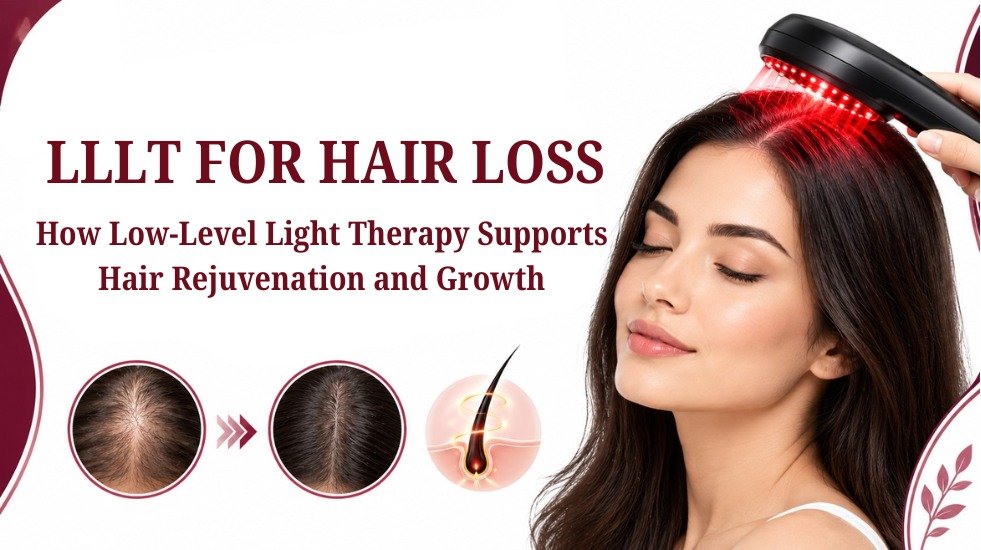
With advances in dermatology, Low-Level Light Therapy (LLLT) for hair loss has emerged as a non-invasive option that may support scalp health and healthier hair growth. Unlike treatments that involve injections or surgical procedures, LLLT uses low-intensity therapeutic light to support the scalp and hair follicles.
However, LLLT is not a universal solution for every type of hair loss. Understanding the cause of hair thinning and receiving a professional scalp evaluation are important before choosing a treatment.
Understanding Why Hair Loss Happens
Hair growth naturally occurs through three main phases:
Anagen Phase
The anagen phase is the active growth stage. During this phase, hair follicles continuously produce new hair strands.
Catagen Phase
The catagen phase is a short transition period when the hair follicle prepares to enter its resting stage.
Telogen Phase
The telogen phase is the resting stage. At the end of this phase, the hair strand naturally sheds and a new growth cycle begins.
Losing around 50 to 100 hairs per day can be normal. However, excessive shedding or reduced hair growth may gradually lead to visible thinning and reduced hair density.
Common causes of hair loss include:
- Male pattern hair loss
- Female pattern hair loss
- Hormonal changes
- Stress
- Nutritional deficiencies
- Iron deficiency
- Vitamin D deficiency
- Vitamin B12 deficiency
- Thyroid disorders
- PCOS
- Scalp conditions
- Ageing
- Certain medications
- Post-pregnancy hormonal changes
Since multiple factors can contribute to hair loss, identifying the underlying cause is an important first step.
What Is LLLT for Hair Loss?
LLLT, or Low-Level Light Therapy, is a non-invasive treatment that uses low-intensity therapeutic light to support scalp health and create a healthier environment for hair follicles.
LLLT for hair loss is designed to complement a comprehensive hair restoration plan rather than replace medical evaluation or other dermatologist-recommended treatments.
The treatment does not involve surgical procedures and is generally considered a comfortable option for people looking for a non-invasive approach to hair rejuvenation.
At a dermatology clinic, LLLT may be recommended after evaluating the patient’s hair loss pattern, scalp condition, medical history, and individual treatment goals.
How Does Low-Level Light Therapy Support Hair Rejuvenation?
The goal of LLLT is to support the scalp environment and maintain healthier hair follicles through therapeutic light exposure.
Depending on the patient’s condition, LLLT may help support:
- Healthier scalp function
- Hair follicle health
- Reduced excessive hair shedding
- Healthier-looking hair growth
- Existing hair strength
- Overall hair rejuvenation
The suitability and expected benefits of LLLT can vary depending on the underlying cause and stage of hair loss.
Potential Benefits of LLLT for Hair Loss
One of the reasons LLLT is considered in hair restoration is that it offers a non-invasive approach.
Potential benefits include:
Non-Invasive Treatment
LLLT does not require injections or surgical procedures, making it an option for individuals looking for a gentle hair rejuvenation approach.
Supports Scalp Health
A healthy scalp provides an important environment for maintaining healthy hair follicles. LLLT may be incorporated into a treatment plan to support overall scalp health.
Supports Hair Follicles
LLLT may help maintain healthier hair follicles and support the hair growth environment.
May Help Reduce Excessive Shedding
Depending on the cause and stage of hair loss, LLLT may be used as part of a personalized plan to help manage excessive hair shedding.
Minimal Downtime
As a non-invasive treatment, LLLT generally involves minimal downtime, allowing patients to continue their usual activities.
Can Complement Other Hair Treatments
LLLT may be combined with other dermatologist-recommended hair restoration treatments when clinically appropriate.
Who May Benefit From LLLT for Hair Loss?
LLLT may be considered for individuals experiencing:
- Early-stage hair thinning
- Diffuse hair loss
- Reduced hair density
- Certain patterns of hair loss
- Hair shedding where a non-invasive option is preferred
- Patients looking to complement other hair restoration treatments
However, not every person with hair loss is an ideal candidate for LLLT.
A dermatologist should first identify the cause of hair loss and evaluate the condition of the scalp and hair follicles.
Can LLLT Be Combined With Other Hair Loss Treatments?
Yes. Depending on the individual’s condition, LLLT may be incorporated into a personalized hair restoration plan alongside other treatments.
A dermatologist may consider combining LLLT with treatments such as:
- PRP Therapy
- GFC Therapy
- Exosome Hair Therapy
- Hair Mesotherapy
- Medical hair loss management
- Nutritional support
- Personalized scalp care
Combination treatment is not automatically better for everyone. The treatment plan should be selected according to the underlying cause of hair loss and the patient’s individual needs.
Why Professional Evaluation Matters Before LLLT
Hair loss can have many different causes. Using a treatment without understanding the underlying problem may delay appropriate care.
A professional hair and scalp evaluation can help assess:
- Type of hair loss
- Duration of hair thinning
- Hair density
- Scalp condition
- Medical history
- Lifestyle factors
- Individual treatment goals
Based on the evaluation, a dermatologist can determine whether LLLT is appropriate or whether another treatment or combination approach may be more suitable.
Why Choose Personalized Hair Rejuvenation Treatment?
There is no single hair loss treatment that works the same way for everyone.
A personalized treatment approach considers the individual’s:
- Hair loss pattern
- Scalp health
- Hair follicle condition
- Medical history
- Lifestyle
- Treatment expectations
LLLT can be an important part of a broader hair rejuvenation plan when recommended by a qualified dermatologist.
Frequently Asked Questions About LLLT for Hair Loss
What is LLLT for hair loss?
LLLT, or Low-Level Light Therapy, is a non-invasive treatment that uses low-intensity therapeutic light to support scalp health and hair follicle function as part of a personalized hair restoration plan.
Does LLLT help with hair growth?
LLLT may support healthier hair growth and hair follicle health in suitable patients. Results can vary depending on the underlying cause and stage of hair loss.
Is LLLT painful?
LLLT is a non-invasive treatment and is generally considered a comfortable procedure with minimal downtime.
How does LLLT support hair rejuvenation?
LLLT uses therapeutic light to support the scalp environment and maintain healthier hair follicles. It may be used as part of a comprehensive hair rejuvenation plan.
Who is a suitable candidate for LLLT?
LLLT may be considered for individuals with early-stage hair thinning, diffuse hair loss, or those seeking a non-invasive option. A dermatologist should evaluate the scalp and hair loss pattern before treatment.
Can LLLT be combined with PRP or GFC?
Depending on the patient’s condition, LLLT may be combined with regenerative treatments such as PRP or GFC. The combination should be recommended by a dermatologist based on individual needs.
Is LLLT suitable for every type of hair loss?
No. Hair loss can result from genetics, hormones, nutritional deficiencies, medical conditions, scalp disorders, and other factors. A proper diagnosis is important before selecting LLLT or any other treatment.
Final Thoughts
Hair loss is different for every individual, which is why treatment should begin with understanding the underlying cause.
The most suitable treatment depends on your hair loss pattern, scalp condition, medical history, and individual goals. A professional evaluation can help determine whether LLLT is appropriate for you and whether it should be combined with other hair restoration options.
If you are looking for LLLT for Hair Loss, Hair Loss Treatment, or Hair Rejuvenation Treatment in Chennai, consult a qualified dermatologist to understand the right treatment approach for your hair and scalp.