
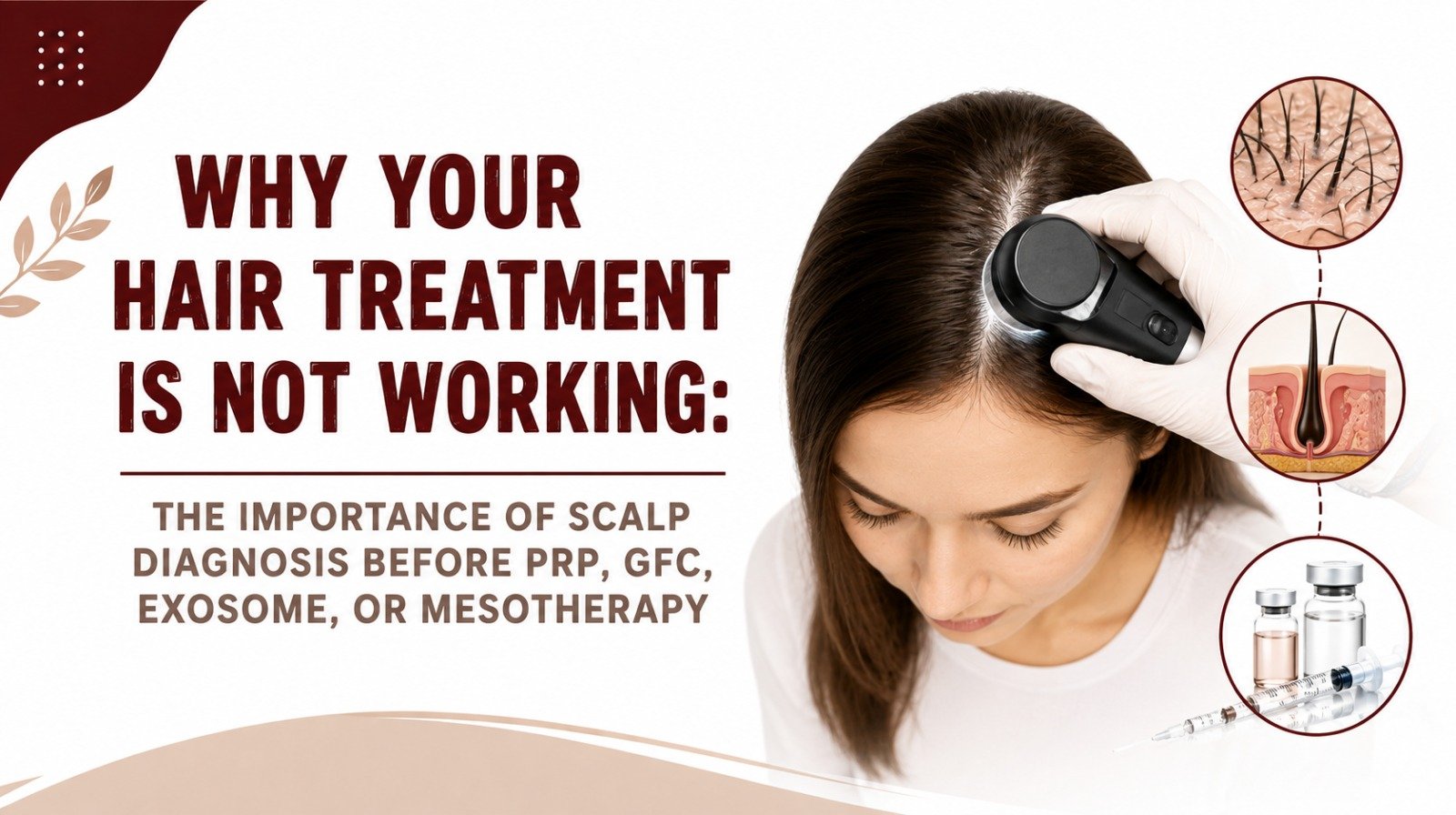
Hair fall can be frustrating, especially when you have already tried multiple treatments but continue to notice thinning, excessive shedding or reduced hair density. Many people move from one popular treatment to another — PRP, GFC, exosome therapy or mesotherapy — expecting visible hair growth.
But there is an important question that is often overlooked:
Do you know why you are losing your hair in the first place?
Hair loss can have many different causes, and the same treatment may not be appropriate for every type of hair loss. A proper scalp diagnosis and hair loss assessment should ideally come before choosing an injectable or regenerative hair treatment. Dermatologists use the patient’s history, examination and, when appropriate, additional tests to identify the underlying cause.
Why Hair Treatment May Not Be Working
One of the most common reasons for disappointing results is treating the symptom instead of the underlying cause.
Hair fall can be associated with several factors, including:
- Male or female pattern hair loss
- Telogen effluvium
- Nutritional deficiencies
- Thyroid-related problems
- Hormonal changes
- Scalp inflammation or infection
- Alopecia areata
- Traction from hairstyles
- Certain medications
- Genetic factors
- Scarring forms of alopecia
The American Academy of Dermatology notes that hair loss has many possible causes and that identifying the cause is important when deciding how to manage it.
This is why simply choosing the “best hair treatment” may not be enough.
What Is Scalp Diagnosis?
A scalp diagnosis is a professional evaluation designed to understand the condition of your scalp, hair follicles and pattern of hair loss.
Depending on your symptoms, a dermatologist may assess:
- Pattern and distribution of hair loss
- Hair shaft thickness
- Hair density
- Scalp condition
- Signs of inflammation
- Itching or scaling
- Family history
- Duration of hair loss
- Recent illness, stress or major life events
- Diet and nutritional factors
- Medications
- Hormonal or medical factors
A dermatologist may also use trichoscopy or dermoscopy to examine the scalp and hair follicles more closely. In certain situations, blood tests or a scalp biopsy may be recommended to investigate the cause further.
PRP, GFC, Exosomes and Mesotherapy Are Not the Same
The increasing popularity of PRP, GFC, exosome therapy and mesotherapy for hair loss can make it seem as though one of these treatments should work for everyone.
That is not necessarily the case.
These treatments differ in their materials, preparation methods, mechanisms and available clinical evidence. Research also varies in terms of patient selection, treatment protocols and outcomes, making direct comparisons difficult.
The appropriate treatment should therefore be determined after understanding the type and cause of hair loss.
PRP for Hair Loss
PRP (Platelet-Rich Plasma) is prepared from the patient’s own blood. The platelet-rich component is processed and used as part of a hair treatment protocol.
PRP has been studied for conditions such as androgenetic alopecia, commonly known as pattern hair loss. Evidence suggests that PRP can benefit some patients, but outcomes can vary depending on factors such as diagnosis, treatment protocol and individual response.
If PRP is being considered, the first question should not simply be “How many PRP sessions do I need?”
It should be:
“Is PRP appropriate for my type of hair loss?”
What Is GFC Hair Treatment?
GFC (Growth Factor Concentrate) is another regenerative approach used in hair-loss treatment. It is designed to concentrate growth-factor components that may support the hair follicle environment.
Emerging clinical research has compared GFC and PRP in male and female pattern hair loss, but treatment protocols and patient responses can differ.
This means GFC should also be considered as part of an individualised treatment plan rather than as a universal solution for hair fall.
What About Exosome Therapy for Hair Loss?
Exosome therapy has attracted considerable interest in regenerative dermatology and hair restoration.
Research suggests potential benefits for hair parameters, but the evidence is still developing. Studies differ in the source and preparation of exosomes, treatment methods and follow-up periods. Recent systematic reviews highlight promising findings while also noting limitations such as small study populations and lack of standardisation.
Therefore, exosome therapy should not be promoted as a guaranteed solution for every type of hair loss.
A proper diagnosis should come first.
Mesotherapy for Hair Loss
Hair mesotherapy involves delivering selected substances into the scalp through multiple small injections.
Research has reported potential benefits for pattern hair loss, but studies have used different substances, concentrations and treatment protocols. More comparative research is needed to establish which approaches work best for which patients.
This is another reason why choosing a treatment solely because it is trending may not produce the expected results.
Why the Same Treatment Does Not Work for Everyone
Imagine two people experiencing hair fall.
The first person has hereditary pattern hair loss. The second has significant hair shedding after a recent illness or nutritional problem.
Although both may describe their problem simply as “hair fall,” the underlying causes are different.
Their treatment plans may therefore need to be different.
Similarly, someone with an inflammatory or scarring form of alopecia may require prompt medical treatment rather than relying only on regenerative hair procedures. Some scarring alopecias can cause permanent hair loss, making early diagnosis particularly important.
Signs You Should Get a Scalp Diagnosis
Consider consulting a dermatologist or hair-loss specialist if you notice:
- Sudden or excessive hair shedding
- Progressive thinning
- A widening hair part
- Receding hairline
- Visible scalp
- Patchy bald spots
- Persistent scalp itching or scaling
- Scalp pain or tenderness
- Thinning that continues despite treatment
- Hair loss that started after an illness or major stress
- No improvement after multiple hair treatments
A professional assessment can help determine whether you are dealing with pattern hair loss, excessive shedding, scalp disease or another condition.
What Can a Proper Hair Loss Assessment Include?
Depending on your symptoms, an assessment may involve:
1. Medical and Hair History
Your dermatologist may ask when the hair loss started, how quickly it is progressing, your family history and whether you recently experienced illness, stress, dietary changes or hormonal changes.
2. Scalp Examination
The scalp and hair are examined for signs that may help distinguish between different types of alopecia.
3. Trichoscopy
A magnified examination of the scalp and hair can provide additional information about hair density, shaft variation and scalp changes.
4. Blood Tests
If your history suggests a possible systemic or nutritional contributor, appropriate laboratory investigations may be recommended. The exact tests should be based on the individual rather than performed as a universal package.
5. Scalp Biopsy When Necessary
A scalp biopsy is not required for everyone. However, when the diagnosis remains uncertain — particularly when a scarring form of alopecia is suspected — it can provide important information.
Diagnosis First. Treatment Second.
The goal of a hair-loss consultation should not be to immediately sell a particular procedure.
It should be to answer:
Why am I losing hair?
Are my follicles still active?
What type of hair loss do I have?
Is there an underlying scalp or medical problem?
Which treatment is appropriate for my condition?
Once the cause has been identified, your dermatologist can determine whether PRP, GFC, exosome therapy, mesotherapy, medication, scalp treatment or another approach is appropriate.
In some cases, a combination of treatments may be considered. In other cases, an injectable treatment may not be the first choice.
How to Choose a Hair Clinic in Chennai
If you are searching for a hair loss treatment in Chennai, don’t choose a clinic only because it offers PRP, GFC or exosome treatment.
Look for a clinic that focuses on hair loss diagnosis, scalp assessment and personalised treatment planning.
A good consultation should help you understand:
- What type of hair loss you have
- Why it may be happening
- Whether your hair follicles are still active
- What treatment options are appropriate
- What kind of improvement can realistically be expected
- How your progress will be monitored
This approach can help you make a more informed decision instead of repeatedly switching between hair treatments.
Frequently Asked Questions
Is PRP suitable for everyone with hair loss?
No. PRP may be useful for selected patients, but suitability depends on the type and cause of hair loss and other individual factors.
Why is my PRP treatment not working?
Possible reasons include an incorrect diagnosis, advanced hair loss, an unsuitable treatment protocol, an underlying medical or scalp condition, or individual variation in response. A reassessment may be appropriate.
Is GFC better than PRP?
There is no single treatment that is universally better for everyone. Evidence comparing PRP and GFC is still developing, and treatment choice should be based on the individual’s diagnosis and clinical situation.
Is exosome therapy proven for hair loss?
Exosome therapy is an emerging treatment with promising early research, but clinical evidence remains limited and heterogeneous compared with more established approaches.
Do I need a scalp diagnosis before hair treatment?
A proper diagnosis is highly valuable because hair loss has many possible causes. Understanding the cause helps determine which treatment, if any, is appropriate.
Conclusion
If your hair treatment is not working, the answer may not be another treatment.
The first step may be finding out why your hair is falling in the first place.
PRP, GFC, exosome therapy and mesotherapy can have a role in selected hair-loss cases, but they should not be treated as one-size-fits-all solutions. A detailed scalp diagnosis and hair-loss assessment can help identify the underlying problem and guide a more personalised treatment plan.
If you are experiencing persistent hair fall, thinning or scalp concerns, consult a qualified dermatologist before choosing your next hair treatment.
Looking for hair loss treatment in Chennai? Start with a professional scalp and hair assessment to understand your condition and determine the most appropriate treatment approach.