
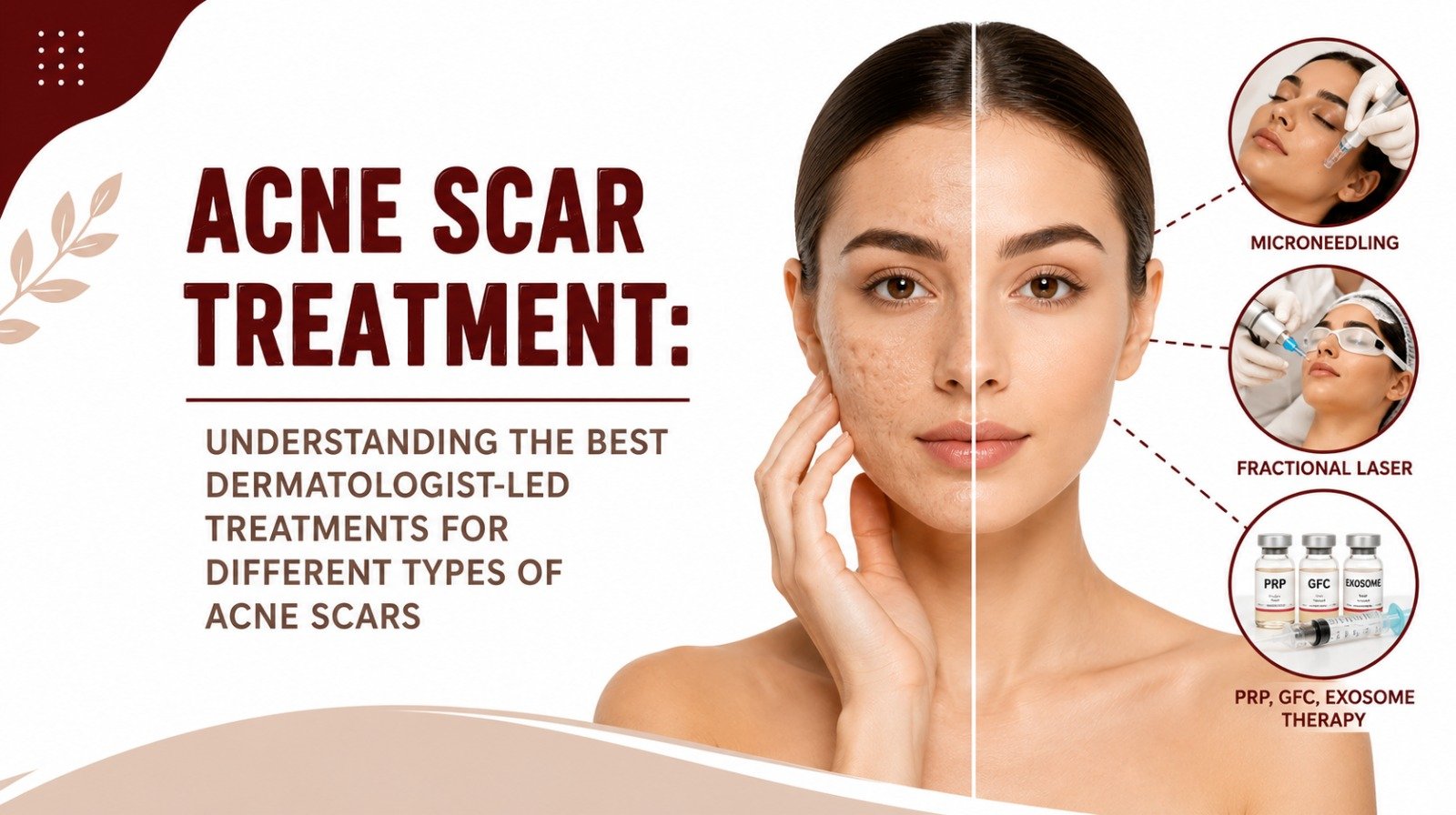
Acne may eventually clear, but the scars it leaves behind can remain for months or even years. For some people, acne scars appear as deep pits, while others experience uneven skin texture, shallow depressions, or dark marks after acne heals. Because these concerns are different, acne scar treatment cannot follow a one-size-fits-all approach.
If you are searching for acne scar treatment in Chennai, the first step is not choosing a procedure. It is identifying the type of acne scar you have and understanding what is causing the uneven appearance of your skin.
At Skyn Care Clinic, acne scar treatment is approached according to factors such as scar type, severity, skin type and individual treatment goals. Depending on the assessment, treatments such as microneedling, TCA CROSS, chemical peels, PRP and advanced skin technologies may be considered as part of a personalized treatment plan.
Acne Marks vs Acne Scars: What Is the Difference?
Many people use the terms acne marks and acne scars interchangeably, but they are not the same.
Acne Marks
Acne marks are mainly changes in skin colour that remain after an acne lesion has healed. They may appear brown, dark or reddish depending on the individual’s skin type and the inflammatory response.
These marks are primarily pigmentation-related rather than structural changes in the skin.
Acne Scars
True acne scars involve changes in the structure of the skin. They can occur when inflammation from acne damages collagen and deeper skin tissue during the healing process.
Acne scars may appear as:
- Ice-pick scars
- Boxcar scars
- Rolling scars
- Raised scars
Because acne marks and structural scars are different concerns, they may require completely different treatment approaches.
What Causes Acne Scars?
Acne scars commonly develop following significant or prolonged inflammation.
Deep inflammatory acne, including nodules and cysts, can damage the deeper layers of the skin. During healing, the body may produce either too little or too much collagen, resulting in depressed or raised scars.
Factors associated with an increased risk of noticeable acne scarring include:
- Severe inflammatory acne
- Delayed treatment of acne
- Repeatedly squeezing or picking pimples
- Prolonged inflammation
- Individual healing response
- Family tendency toward scarring
This is why treating active acne early is an important part of reducing the risk of future scarring.
Understanding Different Types of Acne Scars
Before choosing an acne scar treatment, your dermatologist needs to identify the type of scar.
1. Ice-Pick Scars
Ice-pick scars are narrow, deep depressions that extend into the skin.
Because they are deep and concentrated, surface-level treatments may not always be sufficient. Targeted treatments such as TCA CROSS may be considered for suitable ice-pick scars after professional evaluation.
2. Boxcar Scars
Boxcar scars are wider depressions with relatively defined edges. They can range from shallow to deep.
Depending on their characteristics, treatments that support collagen remodeling, such as microneedling or other dermatologist-selected procedures, may be considered.
3. Rolling Scars
Rolling scars are broader depressions that create an uneven or wavy appearance on the skin.
Their treatment depends on the structure and severity of the scar. Some patients may benefit from collagen-remodeling treatments, while others may require a combination approach.
4. Raised Acne Scars
Some individuals develop excess scar tissue rather than depressed scars. These scars appear raised above the surrounding skin.
Raised scars require a different treatment strategy from depressed acne scars, making professional diagnosis particularly important.
What Are the Best Acne Scar Treatments?
There is no single best treatment for acne scars that works for every patient.
The appropriate treatment depends on:
- Type of acne scar
- Scar depth
- Skin type
- Skin tone
- Active acne
- Pigmentation tendency
- Previous treatments
- Treatment goals
- Expected downtime
Depending on the patient’s condition, Skyn Care Clinic may recommend treatments such as microneedling, TCA CROSS, chemical peels, PRP and advanced skin technologies.
TCA CROSS for Ice-Pick and Deep Acne Scars
TCA CROSS, which stands for Chemical Reconstruction of Skin Scars, is a targeted treatment used for selected depressed acne scars, particularly ice-pick scars and certain narrow, deep boxcar scars.
Unlike a conventional chemical peel, TCA CROSS is not applied broadly across the entire face. Instead, the TCA solution is carefully applied directly into individual scars.
The controlled treatment creates a localized healing response that can support collagen remodeling and gradually improve the appearance of suitable depressed scars.
TCA CROSS may be considered for:
- Ice-pick acne scars
- Selected narrow boxcar scars
- Deep, well-defined depressed scars
- Long-standing deep acne scars
However, TCA CROSS is not suitable for every type of acne scar.
It is not a universal treatment for:
- Broad rolling scars
- Diffuse skin texture problems
- Acne pigmentation
- Dark acne marks
- Active acne
A dermatologist must assess the scar pattern before recommending this treatment.
TCA CROSS vs Chemical Peels
TCA CROSS and conventional chemical peels should not be confused.
A chemical peel is generally applied over a broader area of skin and may be used for acne marks, pigmentation, uneven skin tone and certain superficial skin concerns.
TCA CROSS is a targeted technique, with the treatment applied directly into selected acne scars.
Therefore, the appropriate option depends on whether the primary concern is pigmentation, surface-level irregularity or deeper structural scarring.
Because TCA CROSS uses a stronger chemical agent in a highly targeted manner, professional application is important. This is especially relevant for Indian skin, which can be prone to post-inflammatory pigmentation.
Microneedling for Acne Scars
Microneedling is a collagen-induction treatment that creates controlled micro-injuries in the skin to stimulate the body’s natural healing response.
As the skin heals, collagen remodeling can gradually improve the appearance of certain acne scars and uneven skin texture.
Microneedling may be considered for suitable patients with:
- Certain rolling scars
- Certain boxcar scars
- Uneven skin texture
- Enlarged pores
- Post-acne textural changes
Skyn Care Clinic offers microneedling for acne scars, with treatment plans customized according to scar severity, skin type and individual goals.
Microneedling is not expected to completely erase scars. Instead, the goal is gradual improvement in texture and scar visibility.
Chemical Peels for Acne Marks and Superficial Concerns
Chemical peels work differently from microneedling and TCA CROSS.
A dermatologist applies a carefully selected chemical solution to the skin to promote controlled exfoliation and skin renewal.
Chemical peels may be considered for concerns such as:
- Post-acne pigmentation
- Dark acne marks
- Uneven skin tone
- Dull skin
- Certain superficial skin irregularities
However, chemical peels should not be viewed as a universal treatment for deep structural acne scars.
Deep ice-pick and other depressed scars may require more targeted or collagen-remodeling treatments.
PRP for Acne Scar Treatment
Platelet-Rich Plasma (PRP) is prepared from the patient’s own blood and contains concentrated platelets and naturally occurring growth factors.
Depending on the patient’s condition, PRP may be incorporated into a broader skin-rejuvenation or acne-scar treatment plan.
PRP may be considered alongside procedures such as microneedling when clinically appropriate.
The objective is to support the skin’s natural healing and regenerative processes.
However, PRP is not a universal solution for all acne scars. Its role depends on the individual’s skin condition and the overall treatment strategy.
Sylfirm and Advanced Skin Technologies
Modern dermatology provides several technology-based options for managing skin texture and related concerns.
Sylfirm is one of the advanced technologies available at Skyn Care Clinic.
Whether Sylfirm is appropriate for your acne scars depends on your specific skin concern, skin type and dermatologist assessment.
An advanced technology should not automatically be considered the best option simply because it is newer. The treatment should be selected based on the actual condition being treated.
Why Combination Acne Scar Treatment May Be Recommended
Acne scars often occur alongside other skin concerns.
For example, a person may have:
- Ice-pick scars
- Rolling scars
- Post-acne pigmentation
- Enlarged pores
- Uneven skin texture
One procedure may not address every concern effectively.
A dermatologist may therefore create a treatment plan using different procedures for different components of the skin problem.
For example, TCA CROSS may be considered for selected ice-pick scars, while microneedling may be considered for appropriate textural concerns. Chemical peels may be used for pigmentation or superficial skin concerns, while PRP may be incorporated into selected regenerative treatment plans.
Combination treatment does not mean performing every procedure at once. Treatments are planned according to the patient’s skin and recovery requirements.
Why Indian Skin Needs Personalized Acne Scar Treatment
Indian skin can be more susceptible to post-inflammatory hyperpigmentation, particularly after acne and skin inflammation.
Therefore, acne scar treatment should consider both the structural scar and the patient’s pigmentation tendency.
Your dermatologist may evaluate:
- Natural skin tone
- History of pigmentation
- Scar depth
- Active acne
- Skin sensitivity
- Previous procedures
- Recovery expectations
The objective is to improve acne scars while minimizing unnecessary inflammation and pigmentation-related complications.
This is particularly important when considering procedures that intentionally stimulate a controlled healing response.
Can Acne Scars Be Completely Removed?
It is more realistic to think about improving the appearance of acne scars rather than expecting guaranteed complete removal.
The degree of improvement varies between individuals.
Important factors include:
- Scar type
- Scar depth
- Age of the scar
- Skin type
- Treatment selected
- Number of sessions
- Individual healing response
Some scars may become significantly less noticeable, while deep or long-standing scars may require multiple treatment approaches.
A dermatologist can provide a more realistic expectation after examining your skin.
How Many Acne Scar Treatment Sessions Are Needed?
There is no fixed number of sessions that applies to everyone.
The number of treatments depends on:
- Type of acne scar
- Severity
- Treatment method
- Skin type
- Treatment response
- Individual treatment goals
Some treatments may require multiple sessions spaced apart to allow the skin to recover and collagen remodeling to take place.
Your dermatologist will determine the appropriate treatment frequency based on the procedure being performed.
What Should You Expect After Acne Scar Treatment?
Recovery depends on the treatment.
After procedures such as microneedling, TCA CROSS or chemical peels, temporary redness, sensitivity, peeling or other short-term skin reactions may occur.
Your dermatologist will provide specific aftercare instructions based on the treatment performed.
General principles may include:
- Protecting the skin from excessive sun exposure
- Using recommended sunscreen
- Following the prescribed skincare routine
- Avoiding unnecessary irritation
- Not picking or scratching treated areas
- Following post-treatment instructions carefully
- Attending scheduled follow-up appointments
Sun protection is particularly important for individuals who are prone to pigmentation.
When Should You See a Dermatologist for Acne Scars?
Professional evaluation may be helpful if:
- Acne has left persistent depressions
- You have ice-pick or boxcar scars
- Your skin texture remains uneven
- Dark acne marks are not fading
- You have tried home remedies without improvement
- You are unsure whether you have acne marks or true scars
- Acne scars are affecting your confidence
- You want to understand which treatment is appropriate for your skin
A proper diagnosis can help prevent unnecessary treatments and allow a more targeted approach.
Acne Scar Treatment in Chennai at Skyn Care Clinic
If you are searching for acne scar treatment in Chennai, choosing a dermatologist-led clinic that evaluates your skin before recommending treatment is important.
Skyn Care Clinic in Alandur, Chennai, provides dermatology and cosmetology treatments for a range of skin and hair concerns.
Depending on your condition, acne-scar management may involve treatments such as:
- Microneedling
- TCA CROSS
- Chemical peels
- PRP
- Advanced skin technologies such as Sylfirm
- Personalized combination treatment plans
The treatment selected depends on the type and severity of your acne scars rather than simply choosing one procedure for every patient.
Frequently Asked Questions About Acne Scar Treatment
What is the best treatment for acne scars?
There is no single best treatment for everyone. The appropriate treatment depends on the scar type, depth, skin type and individual goals.
What is TCA CROSS used for?
TCA CROSS is a targeted technique primarily used for selected ice-pick scars and certain narrow, deep acne scars. It is different from a conventional chemical peel.
Can TCA CROSS remove ice-pick scars?
TCA CROSS can improve the appearance of suitable ice-pick scars by creating a controlled localized healing response. The degree of improvement varies between individuals.
Is TCA CROSS suitable for all acne scars?
No. TCA CROSS is most appropriate for selected deep, narrow scars. Rolling scars, pigmentation and superficial acne marks may require different treatments.
Can microneedling improve acne scars?
Microneedling can improve the appearance of certain acne scars and uneven skin texture by stimulating collagen remodeling. Results depend on scar type and individual response.
Are acne marks and acne scars the same?
No. Acne marks are primarily colour changes following inflammation, while true acne scars involve structural changes in the skin.
Can chemical peels treat acne scars?
Chemical peels may be useful for acne marks, pigmentation and superficial skin concerns. Deeper structural scars may require targeted or collagen-remodeling treatments.
Can PRP be used for acne scars?
PRP may be incorporated into selected acne-scar or skin-rejuvenation treatment plans depending on the dermatologist’s assessment.
How long does acne scar treatment take?
Acne scar improvement usually requires a planned treatment course rather than a single session. The duration depends on scar type, treatment method and individual response.
Final Thoughts
Acne scars are not all the same, and treating them effectively requires more than choosing a popular procedure. Ice-pick scars, boxcar scars, rolling scars, raised scars and post-acne pigmentation have different characteristics and may require different treatment approaches.
For selected deep and narrow acne scars, TCA CROSS can provide a targeted treatment approach. Microneedling may be considered for appropriate textural scars, while chemical peels can help address acne marks and superficial skin concerns. PRP and advanced technologies such as Sylfirm may also have a role in personalized treatment plans depending on the patient’s condition.
At Skyn Care Clinic, the focus is on dermatologist-led evaluation and individualized treatment planning rather than applying the same procedure to every patient.
If you are looking for acne scar treatment in Chennai, TCA CROSS treatment, microneedling for acne scars, or treatment for post-acne marks and uneven skin texture, a professional dermatology consultation can help identify the type of scarring you have and determine the most appropriate treatment plan for your skin.